
UXSTM is organized around a domain model: each domain is a typed ISA block (e.g., BIT, INT, WINT, FP, DP/WDP for data-parallel, CR) that can be included or omitted to build a processor profile for a target workload. Inside each domain, UXSTM uses a repeatable domain template: two operand stacks plus two ISA-visible register resources. The result is a uniform execution contract for compilers/JITs and a clean mechanism to configure “universal” cores without changing the fundamental programming model.
The domain template is intentionally stack-first: the canonical operand/result interface is the top of stack (TOS), consistent with well-known stack-execution specifications.
1. Domain Template: Architectural Elements
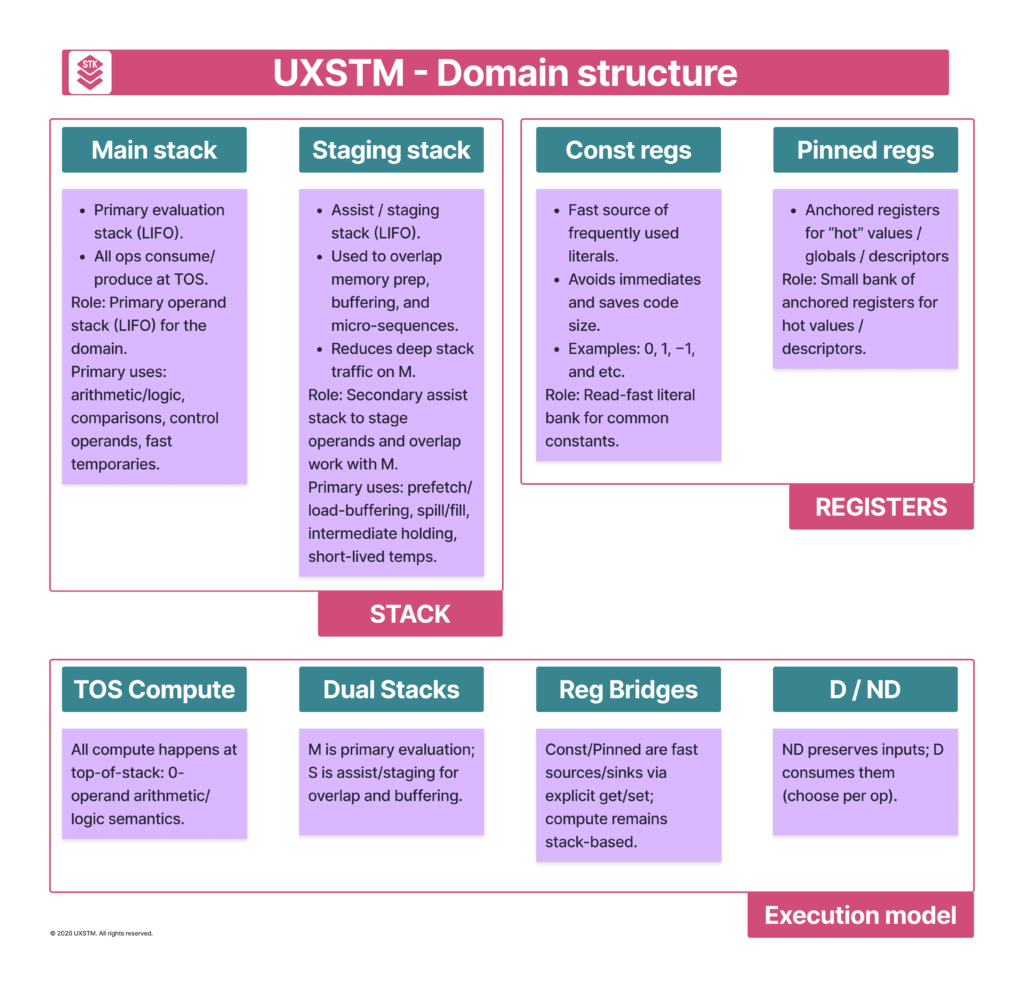
A UXSTM domain is defined by the following ISA-visible elements:
- M-stack (Main) — primary evaluation stack (LIFO)
- S-stack (Staging) — secondary staging/assist stack (LIFO)
- Constant register bank — fast access to frequently used literals (e.g., 0, 1, etc.)
- Pinned register bank — anchored registers for “hot” values / globals / descriptors
All four exist to support one execution principle: operations remain defined over stack tops; registers are auxiliary mechanisms to reduce friction and traffic, not a replacement for stack semantics.
2. M-stack (Main): Full-Function Execution Surface
Definition. The M-stack is the domain’s primary evaluation stack. Most domain operations are specified in terms of TOS semantics:
- operands are taken from the top entries of M-stack (unless an instruction explicitly states otherwise),
- results are pushed back onto M-stack.
Scope. The M-stack supports the complete functional envelope of the domain, including:
- Memory transfers: explicit load/store-style transfers that inject/extract values into/from the stack-based flow,
- Core compute: arithmetic, logical operations, comparisons, and other domain-defined transforms,
- Bit operations: where the domain includes them.
Why this matters. Making the M-stack the “full surface” ensures the architecture remains canonically stack-executed and predictable: the compiler/JIT can reason about execution as “stack in → op → stack out”, and the ISA contract does not devolve into a hidden register machine.
3. S-stack (Staging): Decoupled Prepare Path
Definition. The S-stack is a secondary operand stack intended for staging and servicing, not for replacing the main evaluation flow.
Intended usage. The S-stack exists to handle work that is useful to overlap with M-stack compute or expensive to express as deep-stack manipulation on M.
- Memory-oriented preparation: preloading, buffering, and preparing operands while the M-stack performs compute,
- Lightweight primitives: small bit-ops, inc/dec, and similar low-cost transformations that support preparation workflows,
- Hot-value holding: keeping frequently used values close (in S or pinned regs) to avoid deep-stack rearrangements on M (e.g., avoiding repeated deep
SWAP/DUP-style patterns).
Core idea. S-stack is a second architectural surface. This decoupling is a key lever for reducing stack traffic and enabling higher instruction-level overlap at the core scheduler level.
4. Constant Register Bank: Fast Literals
Definition. The constant registers are an ISA-visible bank that provides frequent literals without repeatedly encoding immediates.
Why constant registers exist
- Code density / decode simplicity: frequently used constants appear across code; providing them as architectural constants can reduce repeated immediate encoding and can keep common instruction patterns compact.
- Lower stack churn: instead of “push literal → use → discard”, constants can be accessed with minimal stack traffic.
5. Pinned Register Bank: Anchored “Hot” Values and Globals
Definition. Pinned registers are an ISA-visible bank of registers intended to hold values that should remain anchored across instruction sequences—values that would otherwise sit deep in the stacks or require repeated shuffling.
Primary purposes.
- Hot operands: frequently reused operands that would otherwise generate deep-stack pressure,
- Descriptors / handles / pointers: stable references used repeatedly in a block or across a VM execution loop,
- Global-like state: selected “global variables” or runtime state that benefits from being consistently accessible,
- Loop invariants / masks: values that should not be repeatedly reconstructed or moved.
Why pinned registers fit a stack-first ISA. In a pure stack machine, frequent reuse can lead to:
- deep-stack growth,
- repeated rearrangement to bring values to TOS.
Pinned registers provide stable anchors that reduce this rearrangement while keeping the canonical operand interface stack-based.
6. Destructive vs Non-destructive Instruction Forms
UXSTM allows instructions to be specified in either of two semantic forms:
6.1 Destructive (consuming)
- operands are popped from the designated stack(s),
- the operation is performed,
- the result is pushed.
This is the canonical stack-machine behavior (“consume → produce”).
6.2 Non-destructive (preserving)
- operands are read from TOS without popping (peek semantics),
- the operation is performed,
- the result is pushed while preserving the source operands.
Why both forms are valuable.
- Non-destructive forms can reduce explicit duplication and rearrangement sequences (fewer “copy-to-top” patterns),
- They offer a more direct mapping for VM/JIT idioms that repeatedly reference the same TOS values while accumulating derived results,
- They provide a controlled trade-off between instruction count and stack traffic.
The UXSTM domain template is built around a simple contract: two operand stacks (Main and Staging) plus constant and pinned register banks, while keeping execution defined over stack tops. M-stack provides the full evaluation surface (including explicit memory transfers and compute), and S-stack provides a decoupled preparation surface that reduces main-stack traffic and enables explicit overlap of staging with computation. Constant registers reduce repeated literal materialization, and pinned registers anchor hot values and runtime state without abandoning a stack-first ISA. Together, these mechanisms make domains composable building blocks for configuring universal cores across workloads, while preserving a strict and predictable execution model.
See Also: